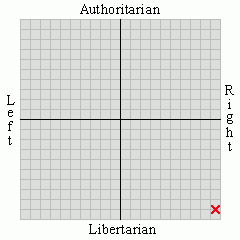
Grab a piece of paper and a pencil. Answer these eight questions with 1) Strongly Agree, 2) Somewhat Agree, 3) Somewhat Disagree, 4) Strongly Disagree, or 5) Not Sure.
I've changed a few of the questions from negative propositions to positive statements, and vice-versa, to make the scoring easier.
Don't just read it. Get a piece of paper and write down your answers.
1) Mandatory licensing of professional services increases the prices of those services.
2) Overall, the standard of living is higher today than it was 30 years ago.
3) Rent control leads to housing shortages.
4) A company with the largest market share is not a monopoly.
5) Third World workers working for American companies overseas are not being exploited.
6) Free trade does not leads to unemployment.
7) Minimum wage laws raise unemployment.
8) Restrictions on housing development make housing less affordable.
Ok, class, before we evaluate your answers, let's discuss a few of the "givens" here. There are things that the overwhelming majority of Biologists simply "know", and take for granted. Photosynthesis, for instance. Biologists don't debate very often about whether it happens.
Math instructors generally don't debate how many 90 degree angles are required to form 360 degrees. Most musicians generally agree that the A above middle C vibrates at 440 times per second.
There are other things that Economists generally "know". Those things are included in the questions above.
If you answered "Strongly Disagree" or "Somewhat Disagree" with any of the statements above, count that as a wrong answer.
Please remember that ease of grading, I've changed the wording on a few of the questions. All of these came from an editorial by Daniel B. Klein, writing for the Wall Street Journal, in a piece called "
Are You Smarter Than A Fifth Grader?" Here's Mr. Klein:
Who is better informed about the policy choices facing the country—liberals, conservatives or libertarians? According to a Zogby International survey that I write about in the May issue of Econ Journal Watch, the answer is unequivocal: The left flunks Econ 101.
Zogby researcher Zeljka Buturovic and I considered the 4,835 respondents' (all American adults) answers to eight survey questions about basic economics. We also asked the respondents about their political leanings: progressive/very liberal; liberal; moderate; conservative; very conservative; and libertarian.
Rather than focusing on whether respondents answered a question correctly, we instead looked at whether they answered incorrectly. A response was counted as incorrect only if it was flatly unenlightened.
Consider one of the economic propositions in the December 2008 poll: "Restrictions on housing development make housing less affordable." People were asked if they: 1) strongly agree; 2) somewhat agree; 3) somewhat disagree; 4) strongly disagree; 5) are not sure.
Basic economics acknowledges that whatever redeeming features a restriction may have, it increases the cost of production and exchange, making goods and services less affordable. There may be exceptions to the general case, but they would be atypical.
Therefore, we counted as incorrect responses of "somewhat disagree" and "strongly disagree." This treatment gives leeway for those who think the question is ambiguous or half right and half wrong. They would likely answer "not sure," which we do not count as incorrect.
In this case, percentage of conservatives answering incorrectly was 22.3%, very conservatives 17.6% and libertarians 15.7%. But the percentage of progressive/very liberals answering incorrectly was 67.6% and liberals 60.1%. The pattern was not an anomaly.
How did the six ideological groups do overall? Here they are, best to worst, with an average number of incorrect responses from 0 to 8: Very conservative, 1.30; Libertarian, 1.38; Conservative, 1.67; Moderate, 3.67; Liberal, 4.69; Progressive/very liberal, 5.26.
Americans in the first three categories do reasonably well. But the left has trouble squaring economic thinking with their political psychology, morals and aesthetics.
To be sure, none of the eight questions specifically challenge the political sensibilities of conservatives and libertarians. Still, not all of the eight questions are tied directly to left-wing concerns about inequality and redistribution. In particular, the questions about mandatory licensing, the standard of living, the definition of monopoly, and free trade do not specifically challenge leftist sensibilities.
Yet on every question the left did much worse. On the monopoly question, the portion of progressive/very liberals answering incorrectly (31%) was more than twice that of conservatives (13%) and more than four times that of libertarians (7%). On the question about living standards, the portion of progressive/very liberals answering incorrectly (61%) was more than four times that of conservatives (13%) and almost three times that of libertarians (21%).
The survey also asked about party affiliation. Those responding Democratic averaged 4.59 incorrect answers. Republicans averaged 1.61 incorrect, and Libertarians 1.26 incorrect.
Adam Smith described political economy as "a branch of the science of a statesman or legislator." Governmental power joined with wrongheadedness is something terrible, but all too common. Realizing that many of our leaders and their constituents are economically unenlightened sheds light on the troubles that surround us.
This reminds me of a P.J. O'Rourke line, from
Eat The Rich, where he talks about systemic poverty in Russia:
I had one fundamental question about economics: Why do some places prosper and thrive while others just suck? It’s not a matter of brains. No part of the earth (with the possible exception of Brentwood) is dumber than Beverly Hills, and the residents are wading in gravy. In Russia, meanwhile, where chess is a spectator sport, they’re boiling stones for soup.
It doesn't matter how smart you are. If enough of your leaders fundamentally disagree with the 8 statements above, you're eventually going to find yourself boiling rocks to make soup.
And if you're a Capital "L" Libertarian and got ANY of these questions wrong, please change your name or change your ways.
 I don't know if this link will work or not, but as a general rule the religious groups scoring the highest, question by question, were Jews, Atheists and Mormons. White and black Protestants were near the bottom on each question.