Among the hundreds of reasons that I'm a libertarian is this little essay by P.J. O'Rourke. It's from "Eat The Rich", a book on economics for the mainstream reader who would otherwise never pick up an economics text. Parts of it are laugh-out-loud funny.
The essay is about the miracle of Hong Kong. Hong Kong is full of Chinese people. They have the same work ethic as China. Same past experience as China. Hong Kong has worse land than China; it's just a rock in the ocean. No natural resources except for the people. With Hong Kong and mainland China you have a near-perfect subject/control group setup for an experiment....
In the previous century, China went into full-blown Marxist/Commie/Socialism. Those poor people went through government-induced famines, economic disasters and purges that had body counts ten time greater than that of The Holocaust. Hong Kong had the good experience of going as Free Market as possible, given the circumstances.
Time magazine just named Hong Kong the best city in the world for 2012.
And yet, just 70 years ago, Hong Kong and China had almost identical standards of living. One became a typical socialist shithole while the other prospered.
(China started liberalizing their economy in the early 80's, but they still have a lot of catching up to do.)
How did this happen? By leaving people the hell alone as much as possible. There were no calls for government to "do something" every time the stock market blipped or someone's puppy ran away.
How a peaceful, uncrowded place with ample wherewithal stays poor is hard to explain. How a conflict-ridden, grossly overpopulated place with no resources whatsoever gets rich is simple. The British colonial government turned Hong Kong into an economic miracle by doing nothing.
Hong Kong is the best contemporary example of laissez-faire. The economic theory of "allow to do" holds that all sorts of doings ought, indeed, to be allowed, and that government should interfere only to keep the peace, ensure legal rights, and protect property.
The people of Hong Kong have been free to do what they wanted, and what they wanted was, apparently, to create a stewing pandemonium: crowded, striving, ugly, and the most fabulous city on earth. It is a metropolis of amazing mess, an apparent stranger to zoning, a tumbling fuddle of streets too narrow and vendor chocked to walk along, slashed through with avenues too busy and broad to cross. It is a vertical city, rising 1,800 feet from Central District to Victoria Peak in less than a mile; so vertical that escalators run in place of sidewalks, and neighborhoods are named by altitude: Mid-Levels. Hong Kong is vertical in its buildings, too, and not just with glossy skyscrapers. Every tenement house and stack of commercial lofts sends an erection into the sky. Picture Wall Street on a Kilimanjaro slope, or, when it rains, picture a downhill Venice.
And rain it does for months. Hong Kong in monsoon season has a climate like boiled Ireland. Violent air-conditioning wars with humid heat in every home and place of business, producing a world with two temperatures: sauna and meat locker. The rainwater overwhelms the outgrown sewer system, which fumes and gurgles beneath streets ranged with limitless shopping. All the opulent goods of mankind are on display in an air of shit and Chanel.
It is a filled-in city, turgid with buildings. The Sham Shui Po district of Kowloon claims a population density of more than 425,000 people per square mile-eighteen times as crowded as New York. Landing at Kai Tak Airport, down one thin skid of Kowloon Bay landfill, you can watch women at bathroom mirrors putting on their makeup. You can tell them that their lipstick's crooked.
There is no space in Hong Kong for love or money, at least not for ordinary kinds of either. A three-bedroom apartment in Central rents for 1,000 $/month, but there isn't room in any of these bedrooms to even have sex with yourself. The whole home will be 700 square feet less than ten yards long by eight yards wide, with windows papered over because, outside those windows, a hand grab away, are the windows of the apartment next door. And anything you're going to fix in the kitchen had better be something that can be stood on end-like a banana. This is how middle-class people live. Poor people in public housing will have three generations in a fifteen-by-twenty-foot room.
But when they come out of that room, they'll be wearing Versace and Dior-some of it even real. Hong Kong is a styling city, up on the trends. Truly up, in the case of platform sneakers. You can spend an entertaining afternoon on Hollywood Road watching teens fall off their shoes. Over the grinding hills, in the blood-clot traffic, men nonetheless drive their Turbo 911s.The S-class Mercedes is the Honda Civic of Hong Kong, and for the soccer-mom set, a Rolls and a driver is a minivan.
Jesus, it's a rich city. Except where it's Christ-almighty poor. Hong Kong is full of that "poverty midst plenty" stuff beloved of foreign correspondents such as myself who, when doing a Hong Kong piece, rush from interviews with day-laboring "cage men" in barred flophouse partitions to dinners in the blandly exclusive confines of Happy Valley's Jockey Club, where I could sample the one true Hong Kong luxury-distance between tables. But, those poor are going to get rich. Just ask them. You can call the old lady selling dried fish on the street on her cell phone.
The bippity-beep of cell phones all but drowns the air-conditioner racket. And each time a cell phone rings, everyone within earshot goes into a self-administered frisk, patting himself down to find the wee gadget. You can go weeks without talking to an answering machine, because you're not really dialing a telephone, you're dialing an armpit, purse, shirt pocket, or bikini top.
The cell-phone has to be there, or somebody might miss a deal. Everything is a deal. In a store you ask: "What's your best price?" then "What 's your Chinese price?" and on from there. I was trying to buy a bottle of cognac in a restaurant. The owner produced a brand I'd never heard of for 100$ and a brand nobody's heard of for 80$. I got my friend Annie, who let fly in Cantonese, and we had a bottle of Remy for one dead U.S Grant. I didn't know you were going to bring my sister in here", said the owner. "Hwa-aaah!"
It is a Cantonese exclamation halfway between oi vey and fuhgedaboutit. Which is Hong Kong in a nutshell-a completely foreign city that's utterly comprehensible. It's a modern place, deaf to charm, dumb in the language of aesthetics, caught up in a wild, romantic passion for the plain utilitarian. The only traditional touches are the catawampus walls and whichaway entrances dictated by feng shui, the art of placing things so as to ensure luck and not to disturb spirits. One building in Repulse Bay has an enormous square hole in its middle so that a certain invisible dragon can get from the mountain to the sea. Knowing Hong Kong, it was probably a scam with a paid-off fortune-teller helping architects and construction companies boost their fees. Some of Hong Kong may believe in geomancy, but it was my local bookstore in New Hamphire that had thirteen feng shui titles.
Everything else quaint within reach in Hong Kong has been torn down. Just a few poky colonial government buildings are left. Landfill has pushed the waterfront a thousand feet into Victoria Harbor. Ferry terminals block the water views, and tides are cramped into a raging flume between Central and Kowloon.
The statue in Statue Square is of a business manager, the nineteenth century chief executive of the Hong Kong and Shanghai Bank. Behind the square, the Hong Kong and Shanghai Bank Building itself rises. Here the local taste for functionalism has been carried to an extreme that arrives at rococo: a massy, looming, steel Tinkertoy of a thing with its whole construction hanging, suspension-bridge fashion, from eight enormous towers. Very functional, indeed, whatever that function is. Maybe to be expensive. It cost a billion dollars to build.
To the west is Jardine House, an aluminium-skinned monolith covered with circular pothole windows-Thousand Assholes, as it's known. To the east is the I.M.Pei-designed Bank of China Tower-all big diagonals and tricky, skinny angles. Its purpose was to be the tallest building in Asia, which it was for about five minutes before being overtopped by Central Plaza a few miles away, and then by twin towers-the tallest enclosed structures in the world-being built at Kuala Lumpur.
A competitive place, Southeast Asia. And it attracts some types that can compete with anything I've seen. I sat at dinner one night between a tough-as-lug-nuts young woman from the mainland who lives in New York and deals in used motor oil-sparkling table talk-and a large and equally adamantine chick from the wrong side of somewhere's tracks in America. I turned to the suicide blond.
"I'm uh arht cunsultunt," she said.
"Come again?"
"Un arht cunsultant."
"That's interesting. Who do you art-consult for?"
She named a large Saudi prince.
"What kind of art does the prince like?" I asked.
"Nineteen-cenchury reuhlist-you know, Uhmerican"
"Any particular artist?"
"Andrew Wyeth"
I'd been under the impression that Andrew Wyeth was still alive-rare in a nineteenth-century artist. And you'd think Hong Kong would be a strange place to look for one of his paintings. But who knows? They shop hard in Hong Kong. Buy hard. Sell hard. They drink hard, too. On Friday nights, police are posted in the Lan Kwai Fong bar district because people have actually been crushed to death during happy hour. Nobody takes it easy in Hong Kong. The only idleness visible is on Sundays, when thousands of the city's overworked Filipino maids come to Central, spread cloths and plastic sheets up and down the sidewalks, and picnic in the least attractive and most heat-baked part of town.
The Filipino maids are Hong Kongese, too. They are in Central because it is practical to get there on the subways, trams, and buses. Hong Kong is a practical place, down to earth, or, rather, down to concrete. The complimentary city guide in my hotel room gave advice on pricing whores and noted, "Some of the conservative hotels don't allow a man to toddle in with a rent-in-bird in the middle of the night. But, as you can imagine there are plenty of 'cheap guest houses'."
In the window of an antique shop, I saw an ivory carving of the familiar row of monkeys:" see no evil, hear no evil, speak no evil; but this one had a fourth monkey with his hands over his balls: fuck no evil.
City of hardheads. City of rough tongues. You are a gweilo right to your face, meaning a white goblin or foreign ghost or old devil or any number of other things, according to how it is said (none of the meanings being complimentary)You can give back as good as you get, however(or try to, since gweilos are famously dim).For instance, the Cantonese really cant distinguish ls from rs.
"Ah,you ordered flied lice," said Annie's gweilo husband, Hugh. "That's fried rice, you plick," said Annie.
I met two women who seemed barely into their twenties but were the publisher and the sales manager of a prominent Hong Kong business magazine.
Publisher: "You are really well-dressed."
Sales manager: "For a journalist. We understand you are a popular writer."
Publisher: "In Japan."
City of straight faces. I was looking at some animal figurines representing Chinese astrological signs. The ancient woman behind the shop counter asked, "What year you born?"
"1947"
"Hwa-aaah. Year of pig! Good luck!"
"Oh, 'Good luck! Good luck!'" I said. "That's what Chinese always say to shopping gweilos. Stolen Ming dynasty grave offerings: 'Good luck!' Can of tuna fish: 'Good luck!' Lacoste shirt: Good luck!'"
"Not so!" she said. "Some years bad luck."
"Such as?"
"Year of buffalo."
"Which year is that?"
"This one."
"This one" being 1997.
I had come to Hong Kong to watch the best contemporary example of laissez-faire be surrendered to the biggest remaining example of socialist totalitarianism.
Hong Kong was (and to be fair to its new commie rulers, remains for the moment) socialism's perfect opposite. Hong Kong does not have import or export duties, or restrictions on investments coming in, or limits on profits going out. There is no capital-gains tax, no interest tax, no sales tax, and no tax breaks for muddle-butt companies that can't make it on their own.
The corporate tax in Hong Kong is 16.5 percent of profits. The individual tax rate is 15 percent of gross income. Hong Kong's government runs a permanent budget surplus and consumes only 6.9 percent of gross domestic product (compared with the 20.8 percent of GDP spent just by the federal government in the U.S) The people of Hong Kong have not been paylings of the state. They are owned their own. They have been able to blow it, Dow Jones it, start a sweater factory, hire, fire, sell, retire, or buy a farm (And there actually are some little-bitty farms in the New Territories).
Hong Kong has never had democracy, but its wallet-size liberties, its Rights-of-Man-in-a-purse, have been so important to individualism and self-governance that in 1995 an international group of libertarian think tanks was moved to perhaps overstate the case and claim, "Hong Kong is the freest nation in the world."
Free because there's been freedom to screw up, too. Hong Kong has no minimum wage, no unemployment benefits, no union-boosting legislation, no Social Security, no national health program, and hardly enough welfare to keep one U.S trailer park in satellite dishes and Marlboro Lights. Just 1.2 percent of GDP goes in transfers to the helplessly poor or subsidies to the hopelessly profitless.
Living without a safety net, people in Hong Kong have kept a grip on the trapeze. The unemployment rate is below 3 percent. In America, a shooting war is usually needed to get unemployment that low. The "natural rate" of unemployment is considered to be about 5 percent in the U.S., which rate would cause natural death from starvation in Hong Kong. But they are not dying. Although smoking is the city's principal indoor athletic activity, life expectancy in Hong Kong is about seventy-nine years, compared with seventy-six in the States. And the infant-mortality rate is comparable to our own. This from people who consider crushed pearls, dried sea horses, and horns from the dead rhinos of Tanzania to be efficacious medicine. Even the babies are too busy to die. Economic growth in Hong Kong has averaged 7.5 percent per year for the past twenty years, causing gross domestic product to quadruple since 1975.With barely one-tenth of 1 percent of the world's population, Hong Kong is the world's eighth-largest international trader and tenth-largest exporter of services.
I'm not exactly sure what "exporter of services" means, unless its fly-by dim sum, but, anyway, it's a fine statistic and helped make dinky, terrifying Kai Tai Airport the third-busiest passenger terminal in the world and the second-busiest air-cargo center. And Kai Tak's solitary runway sticks out into a container port that is the world's most busy of all. Hong Kong's per capita GDP is $26,000.Average individual wealth is greater than in Japan or Germany. It is $5,600 greater than what Hong Kong's ex-colonial masters back in Britain have, and is creeping up on the U.S per capita GDP of $28,600.
Besides Americans, only the people of Luxembourg and Switzerland are richer than those of Hong Kong. And these are two other places where capital is allowed to move and earn freely.
True, there has been an "Asian crisis" since the above statistics were compiled. The Hong Kong stock market has flopped. Indonesia, Thailand, Malaysia, South Korea, and maybe Japan are experiencing depressions. The entire business world of Asia is supposed to be in ruins. But a mere continent wide financial collapse is unlikely to faze the people of Hong Kong.
Hong Kong's economy was destroyed by the Japanese occupation of World War 2, destroyed again by the UN embargo on trade with the Communists in 1951,and almost destroyed a third time by worry about the 1997 handover to China. The territory has been squeegeed by ty-phoons, squished by mudslides, toasted by enormous squatter-camp fires, and mashed by repeated refugee influxes. Hong Kong has no forests, mines, or oil wells, no large-scale agriculture, and definitely no places to park. Hong Kong even has to import water. So in Hong Kong they drink cognac instead, more per person than anywhere else in the world. They own more Rolls-Royces per person, too. So what if there is no space at the curb? They'll hire somebody fresh from the mainland to drive around the block all night.
Why did the British allow this marvel of free enterprise? Why did Britain do so little to interfere with Hong Kong's economic liberty? This is especially hard to answer because, back in London, an ultrainterfering socialist Parliament had taken charge after World War 2.This government would bring the U.K's own economy to a halt like a hippo dropped on a handcart.
Actually, the British did piss in the colonial soup when they could. The crown government held the title to almost all the land in the Hong Kong and the New Territories, and dealt it our slowly to keep sales revenues high. Thus the crowding in a place which, in fact, comprises some 402 square miles of dry ground-enough, in theory, to give everybody a bean-sprout garden. Instead, half the population is stuck in claustrophobic government housing. Then in the 70's,one of Hong Kong's thicker governors, Sir Murray Maclehose, set aside 40 percent of the colony as parkland - cramped comfort to the fellow living in 300 square feet with his wife. Mother, kids, and their Tamagotchi pets.
But the British never tried to install a European-style Pampers-to-June Allyson welfare system in Hong Kong. Maybe the Labour M.P.s were unwilling to invest vast quantities of groundnut scheme-type pinko planning geniuses across the border. Maybe the colonial administrators were overwhelmed by the number of refugees from pinko planning jamming into town. Maybe the mother country was too broke from ruining its own economy in the British Isles. Or maybe the Brits just did not care about pushing social justice down the throats of people who were, after all, only Chinese.
On the other hand, the British were not irresponsible. The "doing nothing" system mentioned at the beginning of this chapter is a relative term. Laissez-faire is not Tanzanian administrative sloth or Albanian popular anarchy.
Quite a bit of government effort is required to create a system in which government leaves people alone. Hong Kong's colonial administration provided courts, contract enforcement, laws that applied to everyone, some measure of national defense (although the Red Chinese People's Liberation Army probably could have lazed its way across the border anytime it wanted), an effective police force (Hong Kong's crime rate is lower than Tokyo's), and bureaucracy that was efficient and uncorrupt but not so hideously uncorrupt that it would not turn a blind eye on an occasional palm-greasing illegal refugee or unlicensed street vendor.
The Brits built schools and roads. And the kids went to school because they knew if they did not, they'd have to hit that road. And the U.K gave Hong Kong a stable currency, which it did totally by cheating-first pegging the Hong Kong currency to the British pound and then, when everyone got done laughing at that, pegging to the U.S dollar at a rate of 7.8:1.Now when there are any money-supply dirty work to be done, Hong Kong can blame everything on Alan Greenspan.
Hong Kong was also fortunate in having a colonial government which included some real British heroes, men who helped of these the place stay as good as it was for a s long as it did.
The most heroic of these was John Cowperthwaite, a young colonial officer sent to Hong Kong in 1945 to oversee the colony's economic recovery. "Upon arrival, however," said a Far Eastern Economic Review article about Cowperthwaite, "he found it recovering quite nicely without him."
Cowperthwaite took the lesson to heart, and while he was in charge, he strictly limited bureaucratic interference in the economy growth or the size of GDP.
(Sorry for the interruption, but I've gotta throw this in....Cowperthwaite famously refused to collect economic statistics, "for fear that I might be forced to do something about them")
The Cubans wont let anyone get those figures, either. But Cowperthwaite forbade it for an opposite reason. He felt that these numbers were nobody's business and would only be misused by policy fools.
Cowperthwaite has said of his role in Hong Kong's astounding growth: "I did very little. All I did was to try to prevent some of the things that might undo it."
He served as the colony's financial secretary from 1961 to 1971.In the debate over the 1961 budget, he spoke words that should be engraved over the portals of every legislature worldwide; no, tattooed on the legislators' faces:
"....in the long run the aggregate of decisions of individual businessmen, exercising individual judgment in a free economy, even if often mistaken, is less likely to do harm than the centralized decisions of a government; and, certainly the harm is likely to be counteracted faster."
Even Newsweek has been forced into admiration: "While Britain continued to build a welfare state, Cowperthwaite was saying 'no': no export subsidies, no tariffs. No personal taxes higher than 15 percent, red tape so thin a one-page form can launch a company."
During Cowperthwaite's "nothing doing" tenure, Hong Kong's exports grew by an average of 13.8 percent a year, industrial wages doubled, and the number of households in extreme poverty shrank from more than half to 16 percent.
"It would be hard to overestimate the debt Hong Kong owes to Cowperthwaite," said economist Milton Friedman. And it would be hard to overestimate the debt Hong Kong owes to the Chinese people who sanctioned and supported what Cowperthwaite was doing or, rather, doing not.
Because Hong Kong did not get rich simply as a result of freedom and law. Economics is easier than economists claim, but its not as easy as that. Chinese culture was a factor in Hong Kong;s success. And yet, almost by definition, Chinese culture must have been a factor in mainland China's failure. Culture is complex. Complexities are fun to talk about, but, when it comes to action, simplicities are often more effective. John Cowperthwaite was a master of simplicities.
Yeung Way Hong, publisher of Hong Kong's most popular Chinese language magazine, Next, has suggested erecting an heroic-scale statue of John Cowperthwaite (To be paid for by private subscription, thank you).
In less than one lifetime, Hong Kong created the environment of comfort and hope that every place on earth has been trying to achieve since the days of homo erectus in the Olduvai Gorge. And Hong Kong's reward? It has been made a "Special administrative Region" of the People's Republic of China.
At midnight on June 30,1997,the British sold six million five hundred thousand souls. No,gave them away. Nearly a Londonful of individuals, supposed citizens of the realm that invented rights, equity, and the rule of law, got Christmas-goosed in July. Hong Kong was on the cuffo, a gimme, an Annie Oakley for the mainland Communists. At the stroke of 12, I was watching TV in my Hong Kong hotel room. The handover ceremony was being broadcast from the hideous new convention center three-quarters of a mile away.
A British military band wearing hats made from Yogi and Smokey and Poo played: "God save the Queen." The Union Jack went south. Prince Charles had just given a little speech. "We shall not forget you, and we shall watch with closest interest as you embark on this new era of your remarkable history." In other words, "Goodbye and bolt the door, bugger you."
Outside, on my hotel-room balcony, the floodlit convention center was all too visible on the harbor front, looking like somebody sat on the Sydney Opera House. Directly below the balcony, a couple thousand not very noisy protesters stood in the rain in Statue Square, looking like somebody was about to sit on them. They were listening to democracy advocate Martin Lee. Mr. Lee was a member of the first freely elected legislature in the history of Hong Kong. And the last. It was unelected at midnight. Mr. Lee was speaking without a police permit. And speaking. And speaking. Every now and then a disconsolate chant of agreement rose from the crowd. Mr. Lee kept speaking. No one bothered to stop him.
Back inside, on the TV, president of China Jiang Zemin was speaking, too-introducing himself to his instant, involuntary fellow countrymen with a poker-faced hollering of banalities in Mandarin.
"We owe all our achievements most fundamentally! To the road of building socialism! With Chinese characteristics! Which we have taken!!!" he said, interrupting his speech with episodes of self-applause, done in the official politburo manner by holding the hands sideways and moving the fingers and palms as if to make quacky-quacky shadow puppets.
The big men on the convention-center podium-Jiang, Prime Minister Li Peng, and Foreign Minister Qian Qichen-seemed to have made their own suit jackets at home. Tung Chee-hwa, the Beijing-appointed chief executive of the new Hong Kong Special Administration Region, came to the microphone next, making pronouncements that combined a political-reeducation-camp lecture ("Our thoughts and remembrance go, with great reverence, to the late Deng Xiaoping)"with a Dick Gephardt speech ("We respect minority views but also shoulder collective responsibility. We value plurality but discourage open confrontation. We strive for liberty but not at the expense of blah,blah,blah.").
This also was said in Mandarin, which is not the native tongue in Hong Kong. In fact, no one uses it there, and having the HK chief executive lipping away in an alien lingo was like hearing an American politician speaking meaningless, bizarre...it was like hearing an American politician speak.
Outside on the balcony again (covering the Hong Kong handover required a journalist to give his utmost-what with AC-chilled binocs fogging in the tropical heat and a minibar running low on ice)? I watched the HMS Britannia pull away from the convention-center dock. A non-descript, freighter-shaped vessel painted white, Brittania looked to be more an unfortunate cruise-ship choice than a royal yacht. It steamed through Victoria Harbour, hauling butt from now foreign waters. On board were the last British governor of Hong Kong, the aristocrat currently known as Prince of Wales, any number of other dignitaries, and, I hope, a large cargo of guilt.
Would the limeys have skipped town if Hong Kong was full of 6.5 million big, pink, freckled, hay-haired, kipper-tucking, pint-sloshing, work-shy, layabout, Labour-voting¡Well, in that case¡
Maybe Hong Kong just was not one of those vital, strategic places worth fighting for-like the Falklands. Maybe the Poms only intervene militarily where there's enough sheep to keep the troops entertained.
Why did not the British give back some other island to China. Britain, for example. This would get the U.K. back on a capitalist course-Beijing being more interested in moneymaking than Tony Blair. Plus, the Chinese have extensive experience settling royal-family problems.
Or why did not Britain sell England to Hong Kong? Hong Kong can afford it, and that way anyone who was worried about the fate of democracy in the Special Administrative Region could go live in Sloane Square, and the rest of England could be turned into a theme park.
There's quaint scenery, lots of amusements for the kiddies ("Changing of the Wives") at Buckingham Palace is good), and plenty of souvenirs, such as, if you donate enough money to the right political party, a knighthood.
But, this didn't happen. And the people of Hong Kong (unless they were very rich) were stuck in Hong Kong. Sure, they had British passports. But, these were "starter passports"-good for travel to...Macao.
Of course, they could have gotten passport upgrades. For a million Hong Kong dollars, they could have gone to Toronto. Very fun.
Oh, lets give the limeys a break. It's not as if we Americans gave a damn, either. We could have threatened to stealth-bomber the Red Chinese or, for that matter, Margaret Thatcher when she started gift-wrapping Hong Kong for Deng Xiaoping. We could have told China to go kiss Boris Yeltsin's ass if it wanted to be a most-favoured nation. And we could have handed out 6.5 million green cards.
Imagine 6.5 million savvy, hardworking citizens-to-be with a great cuisine. What a blessing for America. And how we would hate them. Pat Buchanan would hate their race. The AFL-CIO would hate their wage rate. The NAACP would hate their failure to fail as a minority. And, Al Gore would hate 6.5 million campaign contributors who didn't have to sneak pro-free-trade money to the Democratic National Committee anymore but could go right into polling booths and vote Republican.
The surrender of Hong Kong was a shameful moment. But if you missed Martin Lee's soggy peroratition in Statue Square, you might never have known it.
The stock market was still on a swell, up 30 percent from a year before, with bulging, steroidal gains in the so-called red chips, the mainland holding companies promoted by the ChiComs. Trade and foreign investment were at unexampled heights. No one was running from the real-estate market. Tiny condominiums in unglamorous districts were going for $500,000.
A five-day weekend was declared, though no one closed shop. Retail sales were 30 percent to 40 percent above the usual. Important people had flown in from all over the globe. I saw the back of Margaret Thatcher's head in my hotel lobby.
On July 1("Dependence Day," I guess) people who should have known better sent messages of cheer, fulsomely printed in the South China Morning Post:
"China has made important commitments to maintain Hong Kong's freedom and autonomy".-- Bill Clinton
"Hong Kong can be an ever better place in which to live and work."-- Madeleine Albright
"I feel pretty relaxed about it."-- George Bush
Skyrockets splattered in the evening skies. The British Farewell Ceremony for 10,000 invited guests had featured not only bands from the Scots Guards, Black Watch, and various other men without pants, but also from Hong Kong Philharmonic Orchestra and (I saw this) a dance troupe with performers dressed as giant deutsche marks, enormous circuit boards, and huge powdered wigs. At the other end of the lifestyle continuum, there was a One Nation Under a Groove 11 p.m to 9 a.m rave.
In between were thousands of parties, from impromptu expat booze-ups in the Wan Chai lap-dancing district to dinners with courses incalculable by abacus at Hong Kong mogul David Tang's China Club.
Here the whole food chain was ravaged, from depth of sea slug to bird's nest height. The China Club is decorated colonial style in big-wallah mahogany, except the walls are covered with Mao-era socialist-realism art, and the waiters and waitresses are dressed as Red Guards. Meaning? I have no idea.
I also have no idea why my hotel kept giving me handover gifts: a bottle of champagne, a coffee-table book about Hong Kong titled Return to the heart of the Dragon (less ominous-sounding in Chinese, I gather), and a silver mug bearing crossed British and Chinese flags, and inscribed:
Resumption of Sovereignty
To China
1 July 1977
Hong Kong
To which I intend to have added:
Bowling Tournament
2nd place
Whimsical handover T-shirts, many making hangover puns, were for sale around the city, as such humorous novelties as "Canned Colonial Air-Sealed before June 30th." I suppose the same sort of things were being marketed in Vienna in 1938: "Last Yarmulke before Anschluss," and so on. Maybe in occupied France, too: "Vichy Water," ha-ha.
There were grumbles in Hong Kong, of course, such as dissidentish shows by artists objecting to censorship, in case there was going to be any.
Martin Lee and his fellow Democratic Party members gave a glum press conference, at which they promised to keep representing their electoral districts, even if they didn't anymore. And a certain amount of fretting in the press was seen, but mostly of the affectless editorial page kind that mixes After Genocide-Wither Rwanda? With After Gretzky-Wither Hockey? Hong Kong on the whole, was awfully darn cheerful.
Why weren't 6.5 million people more upset about being palmed off to an ideology-impaired dictatorship that has the H-bomb? Even one of Taiwan's top representatives in Hong Kong was quoted saying, "As a Chinese person, I think it is a good thing that Hong Kong is coming back to China." Chiang-Kai-shek, please.
There is the colonialism issue.
How did the Chinese of Hong Kong really feel about being ruled by England? It's a complex question. Or, as a number of Chinese people said to me, "no, it isn't." Being an American, an Irish-American to boot, I was maybe, told certain things that the English did not hear. "We hate the English," for instance.
When a Chinese friend said that, I said, "wait a minute was in Vietnam not long ago, and nobody seemed to hate Americans. If the Vietnamese can forgive the Americans for napalm, carpet bombing, agent orange, and what-all, surely you can forgive the English for the odd opium war and some 'Land of Hope and Glory' karaoke"
"It's a different thing," said my friend. "You just killed the Vietnamese; you never snubbed them."
Hong Kong's people are also realists. Calling in to complain on the Larry King Show wasn't going to do much. Thus the tepid response to the handover's endless television and newspaper "streeters", the interviews with random locals: "Excuse me, I understand you're about to get secret police in your neighbourhood. Would you care to tell the world how much you hate Jiang Zemin?"
There are real reasons for Hong Kong's realism. In 1945 the population of the territory was only 1.2 million. Today, the whole city is filled with refugees and children of refugees. Until 1981,Hong Kong had a "touch base" asylum policy where, basically, anyone from the mainland who made it to downtown could stay.
The Chinese who fled the civil war, the communist takeover on the mainland, and the lunatic deprivations and slaughters that followed know that there's only one real safe haven: money.
Why do so many of our Statist friends fear large corporations (a large group of people looking out for the interest of the organization, rather than individuals), but have a deep and abiding love of Big Government (a large group of people looking out for the interest of the organzation, rather than individuals)?
Go here to marvel at the website of "Jews For The Preservation Of Firearms Ownership"
The site refers you to the chart I've included below. Here's some info on where these guys are coming from:
Why must all decent non-violent people fight against "gun control"? Why is the right to keep and bear arms truly a fundamental individual right? You can find the answers in this new book.
People frequently ask why we are so dedicated to our cause? This book answers that question by collecting the key facts and arguments in one place.
The message is simple: Disarmed people are neither free nor safe - they become the criminals' prey and the tyrants' playthings. When the civilians are defenseless and their government goes bad, however, thousands and millions of innocents die.
Professor R.J. Rummel, author of the monumental book Death by Government, said: "Concentrated political power is the most dangerous thing on earth." For power to concentrate and become dangerous, the citizens must be disarmed.
What disarms the citizens? The idea of "gun control." It's the idea that only the government has the right to possess firearms, and that citizens have no unalienable right to use force to defend against aggression.
Death by Gun Control carefully examines the "gun control" idea: its meaning, its purposes, its effects. It comes in many forms, but in every form it enables the evildoers and works against righteous defense.
I've long thought that if election results really matter to you, then your government is too big. Elections should matter about as much as choosing a new lawn service.
....in the spirit of bipartisanship I’ll go ahead and endorse Alvin Greene in addition to Paladino and O’Donnell. Politics is a ridiculous profession populated by ridiculous people. Maybe if we elect increasingly clownish candidates, the public will eventually come to realize this, and finally realize that it’s probably not a good idea to put larger and larger portions of our lives and livelihoods in the hands of people who have achieved success in a field that rewards character traits you spend your entire tenure as a parent trying to teach out of your kids.
I’m kidding about endorsing Greene, O’Donnell, and Paladino, but only because their election would give them actual power. But I see no particular reason to root for their opponents, either. And I see no reason to instinctively cheer for Republicans over Democrats. Or vice versa. At least electing transparently crazy people will make us more cautious about how they use their power.
Seriously....is Alvin Greene that much sillier than Nancy Pelosi, Trent Lott, or any other Pork Merchant?
Me, I’m cheering for elections to matter less, and for politicians to have less impact on my life. I dream of waking up to find the results of the November 2 election on page A-10 of my November 3rd newspaper—because no one cared, because very little was at stake, because we stopped pinning our hopes and dreams on the results of a perverse process dominated by generally horrible people who have made a career of accumulating power for the sake of accumulating power.
Incidentally, this is also how you “get money out of politics.” You make politics and political outcomes less important. I’m amused by people who are surprised that as the power, scope, and influence of government grows, interest groups are correspondingly willing to spend increasingly more money to purchase a piece of that influence. I actually once heard a prominent lefty journalist express this very sentiment. They’re shocked by this!
Yes, without exception. Shocked, I say! Shocked !
It’s even cuter that they think they can continue to expand the size, scope, and influence government and prevent the government from being corrupted . . . by giving the same government yet more power, in this case to prevent itself from being corrupted. Inevitably, these new powers then manifest as new restrictions on our ability and freedom to criticize politicians. Because that’s their solution to the corruption of our politicians: Less criticism of politicians!
You cannot decrease government corruption, bribery, earmarking, pork-barreling, featherbedding, and favoritism by writing more laws. The purpose of those laws is to sell exemptions to those laws. The only way to decrease the size and scope of the problem is to make the government smaller. Much, much smaller. Small enough to drown in the bathtub.
Go here to listen to Steve Martin's "Let's Get Small".
In today’s New York Times, Bill Clinton once again tries to tie the Oklahoma City bombing to those of us who hold “the belief that the greatest threat to American freedom is our government, and that public servants do not protect our freedoms, but abuse them.”
Of course he sort of proves those of us who do believe such things right by continually using April 19 to tie us to a deranged murderer instead of acknowledging, taking some responsibility for, or expressing any remorse whatsoever for another anniversary we observe today: the Clinton administration’s slaughter of 76 people, including 20 children, at the Branch Davidian compound in Waco. Waco gets all of a sentence in Clinton’s op-ed.
Wow. Bill should have checked his calendar a more closely before hitting the "send" key on that one. Clinton's NYT OpEd is nothing more than the latest step in the administration's opposition demonization program: The Tea Party protesters are all racists. Opposition to The Obamessiah is unpatriotic. How could you dare say that you want the President to fail. If you oppose The Teleprompter Jesus, you're encouraging irresponsible behavior. Well, good luck to 'em. They're going to need it. Here's something else from Balko's site: A Pew Research survey that goes all the way back to Ike. It charts the level of "trust in government".
As a libertarian, of course, you want to see this line dipping on down into the single digits until government is trusted with nothing more than roads, sewers, protecting the borders, and selling raffle tickets for their annual fund-raiser.
Back to Balko. Here's are his closing paragraphs:
The thing is, Mr. Former President, if I may address you directly, is there are far too may public servants who, as you put it, “do not protect our freedoms, but abuse them.” I document them every day on this site. And so despite your admonition, I will continue to criticize them for it. And when, for example, they out and out murder innocent people in the name of a senseless, wasteful, and fundamentally illiberal policy (a policy, incidentally, that you enthusiastically support, despite your admission that you yourself have broken the country’s drug laws), I’ll go ahead and, to borrow your word, demonize them for it.
And you know what? I won’t feel the slightest tinge of guilt about doing so. Nor will I feel the least bit of responsibility for acts of anti-government violence, past or future, even when they’re committed in the name of one or more ideas I might otherwise endorse.
Because fundamentally and categorically, I repudiate the use of force and violence to impose my beliefs, political philosophy, or policy preferences on other people. Until you can say the same thing, Mr. Former President (and we both know you can’t), you can spare me your goddamned lecture.
Think of your best experience ever at the Department Of Motor Vehicles. Then compare that unlikely memory to your worst experience at a Wal-Mart. The occasional long lines or the difficulty you might have getting help from time to time.
Think of the busiest Post Office you've seen in the past year. Compare that to the slowest Wal-Mart (granted, a slow Wal-Mart is sort of a contradiction.)
If you've ever done any building contracting, think of the most delightful experiences you've had with city electrical, plumbing, and mechanical inspectors. Think of how prompt they always were for their appointments, plus or minus six hours. Remember the what it was like navigating through their f***ing automated phone trees and getting sent to the same damn recording multiple times. Compare that to the times you've found a Wal-Mart out of stock on anything but the hottest Christmas items.
If you happen to work for a Wal-Mart supplier (Full Disclosure: I do), and you work in the shipping and freight end of things, did you notice some of the guys that The Teamsters started sending out from YRC about a year ago? I bet it takes some of those guys five or six tries to back up to a handicap-stall toilet. And yet those dangerous, low end, non-union Wal-Mart drivers can always, without fail, back up to the gates of Hell without pulling forward to straighten up a single time.
Compare the U.S. government's response to Katrina....
....with that of Wal-Mart.
Then, when you're finished with all of those mental gymnastics, go here.
If it's ok to take someone's money to build a road. Is it also ok to force someone to do the labor required to build it? Why is it always assumed that it's ok to take money but not labor? Why do the people who build the roads need to be paid? Why don't the poor people, who are getting all the benefits of socialism, but aren't contributing, do their "fair share" by working in press gangs to build roads and parks? The answer is easy. The answer is "slavery is wrong". But for some reason we don't consider it slavery if we steal someone's past labor. Only if we steal their current labor.
A few weeks ago we had a vote on whether to have a community sign provided by the city government, paid for with taxes. I cast the lone dissenting vote. While the amount of money is small relative to the overall budget, our budget is very tight and we made lots of cuts to avoid raising taxes. Therefore this expense, though small, should not stand while other more urgent causes are cut. However, the real problem is not financial. I warned that having such a sign would result in a fiasco of contention and rancor over policy. Last night’s council meeting proved my point.
Our city staff prepared a draft policy for the sign at last night’s meeting. It contained an exclusion for content of a religious nature, which I support. In order to clarify the interpretation of this policy I started the questioning by presenting several examples from the church I attend. A fellow councilman asked if a vacation bible school could be advertised. This went on a good long while with the mayor concluding he doesn’t have any problem with using taxpayer’s money for advertising items of a religious nature.
Let me set some further context here. We begin council meetings with a prayer to Jesus Christ. I oppose this. I haven’t actively done anything about it because I have so many other battles to wage, but I would certainly welcome a policy change here.
Why would a Catholic who goes to church twice every Sunday oppose religion in city politics?
Perhaps you are familiar with the first amendment to the US Constitution. Perhaps you are aware of the inspiration the first amendment derived from Thomas Jefferson. Perhaps you are aware that Muslims, Jews, Atheists, and others have the same rights as Christians. Perhaps the Muslim, Jew, or Atheist wonders if they will get a fair shake on a zoning variance after the entire council prays to Jesus. Perhaps you are aware of the atrocities of the Taliban.
I take my faith seriously. I do not need George Bush, Bill Clinton, or any other politician being the middle man in my relationship with God. If we continue to empower politicians to take our money to promote their church, what happens when their church isn’t your church?
Now ask yourself, do I sound like a Republican to you?
Let me be more clear:
•I cast the lone dissenting vote against an ordinance allowing government to ban cell phone use in school zones •I cast the lone dissenting vote to renew our curfew law
It is easy to stand on the sidelines and call yourself one thing or another. The true test of your identity is when you are outnumbered but refuse to compromise your principles.
So, do Libertarians hurt Republicans? Yes, when they are in power. We have had Republicans in power until recently and Libertarians have appealed more to voters that see their failure of leadership. The same will happen with Democrats. Research proves it.
If a government is big enough to control health care, it's big enough to prohibit gun ownership.
If a government is big enough to prohibit gun ownership, it's big enough to control marriage.
If a government is powerful enough to outlaw gay and lesbian marriage, it's probably big enough to print worthless money to pay off its debts.
If a government is arrogant enough to flood the market with devalued currency, it probably won't hesitate to involve us in expensive foreign wars.
If a government is big enough to get into overseas adventures, it's probably big enough to staff military bases in 46 other countries.
If a government has 750 military bases overseas, it's probably irresponsible enough to burden its citizens with Eleven Trillion Dollars in debt.
If a government overreaches enough to burden each taxpayer with $40,000 in debt, it's big enough to protect its Federal Reserve system from an audit.
If a government is powerful enough to shelter its reserve banks, it's powerful enough to bail out favored industries and Troubled Assets.
If a government is arrogant enough to bail out campaign supporters with your money, that government won't hesitate to proscribe what substances you can and can't consume, ingest, or inhale.
If a government overreaches enough to outlaw recreational drug use, it won't hesitate to define how your children can be educated.
If a government is large enough to ban home schooling, it's big enough to set quotas and taxes on all commodities that enter its borders.
If a government is big enough to protect favored industries by putting ridiculous tariffs on imports, that same government is big enough to control your healthcare decisions.
Here's Radley Balko, posted at his Agitator Blog back on June 4th:
It was 20 years ago today that the Chinese government killed 2,000 to 3,000 of its own citizens for the crime of demanding their own liberty. This iconic photo is about all that’s left of them. George Orwell said, “If you want a vision of the future, imagine a boot stamping on a human face—forever.” He’s all too right. Last century, an estimated 262 million people were murdered by their own government . That doesn’t include the hundreds of millions more killed by opposing governments during war. Today ought to be a day to celebrate and promote human liberty, and to remember the abuses governments have heaped upon their subjects over the centuries. So go find your own metaphor for the government tank pictured above. Then put yourself in front of it.
This thing is more than nine minutes long. I had no intentions of watching all of it. I've now watched it twice. Iowahawk. Often imitated, never duplicated.
But now comes yet another cause du’jour that is both ludicrous and deathly dangerous all at the same time. From the editorial pages of the Washington Post and the New York Times has come the clarion call for an entire new Department of Government: a Department of Culture. Now, seeing what has happened to education since the creation of the Department of Education, or the state of Housing under the guidance of that august agency, I can understand those who are a bit nervous about a Department of Culture. And well they should be nervous, if not in a downright state of panic.
Bill, I think you need to relax.
I'll admit that governmental goofiness in the public schools is creating a plethora of private academies and an exodus to the suburbs. Government housing boondoggles have long been a corrupt landlord honeypot. V.A. Hospitals are the warm-up act for the medical care we'll get if [the President-elect] is true to his word on socialized medicine.
People seldom use the U.S. Mail for anything vital. The Department of Agriculture never met a millionaire farmer that it didn't abolutely adore.
But a cabinet level Department of Culture could be wonderful, IF they would allow me to design the facility in which it is housed.
I want to design the place, inside and out, as a living, breathing symbol of government involvement in our national culture.
I want to model the facility along the lines of Chicago's Cabrini-Green housing project. I can't build an exact replica because the Cabrini-Green building won't sit still long enough to be properly imitated. That place has been morphing into various screwed-up shapes and sizes ever since the government realized they'd screwed up by building it in the first place. If you're not familiar with Cabrini-Green, here's Wikipedia:
Cabrini-Green is a Chicago Housing Authority (CHA) public housing development on Chicago's North Side.... At its height, Cabrini-Green was home to 15,000 people, living in mid- and high-rise apartment buildings. Over the years, gang violence and neglect created terrible conditions for the residents, and the name "Cabrini-Green" became synonymous with the problems associated with public housing in the United States.
My architectural homage to the Cabrini-Green facility will never be finished either, symbolizing the constant re-birthing of Art and Culture. A statue of a giant wrecking ball near the entrance would also symbolize constant employment for all my contractor donors and buddies, which is all that matters.
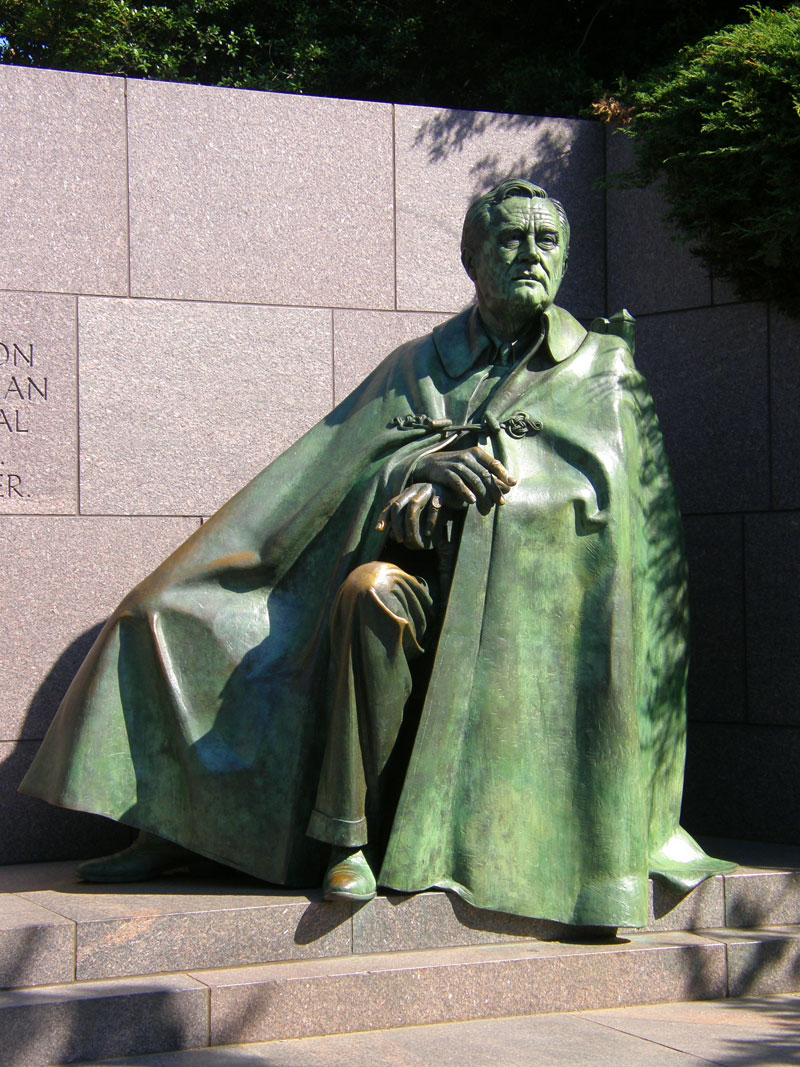
At the top of the steps leading to the Department of Culture (D.O.C.), I intend to place a duplicate of this truly godawful statue from the FDR memorial.
You might remember some controversy about this sculpture. FDR went to great lengths to conceal his partial paralysis from the public (only two photos of him in his wheelchair are known to exist). But various special interest groups lobbied for the wheelchair to be included in any and all sculptures of FDR. Like it or dislike it, the result would horrify FDR.
Two years ago, as the controversy over the monument was fomenting, David Roosevelt said the memorial should not be ''a vehicle for making a social statement.'' But as Mr. Clinton noted today, 16 of Roosevelt's grandchildren have now called for a more vivid depiction of his disability, as have former Presidents George Bush, Jimmy Carter and Gerald R. Ford.
Hence the cape around the (assumed) wheelchair on this particular statue at the memorial. Art by compromise. You gotta love it.
So if my Department is going to advocate "vivid depictions of disabilities", I want to have another statue in the rotunda of the D.O.C. to vividly depict the disabilities endured by Clinton, Bush, Carter and Ford.
After leaving the rotunda, visitors and employees will encounter the "Piss Christ" fountain, based on the government-rewarded artwork by American photographer Andres Serrano, which depicts a small plastic Christ On The Cross submerged in a glass of Serrano's urine. Serrano got $15,000.00 from the National Endowment for the Arts as a reward for producing this photo. The Piss Christ Fountain will be immediately behind the D.O.C. rotunda, eliminating the need for restrooms in that area, but slightly increasing the space required for the mop closet.
(Like many of you, I think $15,000.00 was too high of a price for a mere photograph. If Andres Serrano is going to have any more works funded by my D.O.C., he's going to have to fill the fountain first. The hard way. We'll provide him with plenty of water for, ummm, processing.)
As visitors leave the P.C. fountain, they will be drawn into the corridor of Lighght. Yes, Lighght.
"Lighght" is both the title and the complete text of a one-word poem by Aram Saroyan, for which Saroyan received $750 from the NEA, way back in 1970 when that was real money. But think about it. Lighght. Lighght.
So perfect.
That poem'll make you throw rocks at Shakespeare, The Psalms, or almost any limerick you can think of. Lighght. I'll have it on the walls. It'll be written on the floor. Lighght. Lighght.
In the midst of all the Lighght, I'll construct a small podium which will give two paragraphs of additional information about the Lighght poem. I don't have room to reproduce the text here, but hit on this link to be enlighghtened, and ghghet back to me after readinghgh. It's O So Serious, and very much worth the trip.
Look below. Very closely. Lighght is there. This is a signed and numbered silkscreened print of the lighght poem that you can purchase through The Paris Review. They don't list the price - they only give an email address to which you can send enquiries. It's available in a limited edition of 150.
Damn, I wish I had typed that.
Visitors ghghoing throughgh throughgh the ghghlass hall of lighght will be ghghiven a chance to ghghive ghghenerous donations toward fundinghgh more of Saroyan's work.
After leaving the hall of lighght, visitors will enter a vast network of administrative offices. There will be thousands and thousands of offices, so I will need thousands and thousands of government bureaucrats to staff these offices. Otherwise, I will be perceived as wasting office space (government waste is a BIG no-no at my D.O.C.) Plus, as the currently fashionable logic goes, this will create jobs.
Every office will have a flatscreen TV playing Ken Burns' series on The Civil War, 24 hours a day, 7 days a week. This is an homage to the importance of Ken Burns' documentaries in obtaining funding for the National Endowment For The Humanities every year at renewal time. Without Ken Burns, the NEH would have very little except a motley band of performance artists who sing the ingredients of cereal boxes while shaving a gong with an electric razor. (I don't know if the performance artist shown below gets any NEA or NEH funding for his art, but when I open the Department Of Culture to the general public, this guy's going to play a role in the opening ceremony. I hope he uses a gong.)
Of course, no government ripoff can ever be fully funded without saccharine pleas that the boondoggle/bailout/subsidy/giveaway under discussion is "for the children". I'll have a large Children's Art Center near the exit of the Department Of Culture, fully equipped with modeling clay, fingerpaint, brushes, canvas, poster board, easels, drum sets, fighter pilot helmets, and toilets. After a long day spent touring the D.O.C., the little kiddos can create their own piece of American Culture !
The kids will have to pay a small fee to participate. They'll have to pay another fee to have their art considered in the Best Of The D.O.C. competition. And to have a shot at winning, they'll voluntarily make an additional contribution to each judge's re-appointment campaign. Therefore, I'm going to name the children's area The Rod Blagojevich "Pay To Play" Pavillion.
All guests and employees will leave The Department Of Culture through the base of a giant mural called "The Robert Mapplethorpe Exit".
So please write your representatives, and let them know that you're in favor of creating The Department Of Culture.
I fear for my country when I think of a Democrat president and Democrat congress.
According to Reason magazine, my fears are somewhat justified.
Here's Veronique de Rugy, writing in the November 2008 issue:
"When it comes to out-of-control spending, conventional wisdom says the Democrats are most likely to bust open the coffers. That's why many fear an increased Democratic majority in Congress topped by a Democratic president. And we should be afraid. Democrats are indeed big spenders. Second only to Republicans."
If limited government is the goal, history tells us we should root for Democratic presidents and Republican Congresses. And regardless of party, _________'s should be kept far away from the White House."
I'll fill in the blank in a minute.....
She goes on to rank the various combinations of discretionary spending from mediocre to worst:
1) Democratic White House, Republican Congress
2) Republican White House, Democratic Congress
3) Unified Republican or Democratic rule.
De Rugy believes that growth in discretionary spending is the best indicator of financial responsibility, simply because it can be written out of the books each year. (It's only fair to mention that no one has ever decreased the total. Some combinations merely allow it to grow slower than others.... And she doesn't mention which combinations voted to approve the largest increases in non-discretionary spending. That would go back to FDR.)
And what group should be prevented from entering the White House under any circumstances, if reduced spending is your goal?
Not Democrats, and not Republicans.
Texans.
Yes, Texans.
"During the last 48 years, the six largest annual percentage increases in real discretionary outlays were split between two presidents, Lyndon Johnson and George W. Bush.....While LBJ and GWB increased discretionary spending between 6.6 percent and 14.8 percent in their most profligate years, the average annual increase during the last 48 years has been a much more modest 1.7 percent."
So, to everyone living in the other 49 states, the next time you see one of these Lone Star State bumperstickers?


 A few weeks ago we had a vote on whether to have a community sign provided by the city government, paid for with taxes. I cast the lone dissenting vote. While the amount of money is small relative to the overall budget, our budget is very tight and we made lots of cuts to avoid raising taxes. Therefore this expense, though small, should not stand while other more urgent causes are cut. However, the real problem is not financial. I warned that having such a sign would result in a fiasco of contention and rancor over policy. Last night’s council meeting proved my point.
 It was 20 years ago today that the Chinese government killed 2,000 to 3,000 of its own citizens for the crime of demanding their own liberty. This iconic photo is about all that’s left of them.

 You might remember some controversy about this sculpture. FDR went to great lengths to conceal his partial paralysis from the public (only two photos of him in his wheelchair are known to exist). But various special interest groups lobbied for the wheelchair to be included in any and all sculptures of FDR. Like it or dislike it, the result would horrify FDR.


 Of course, no government ripoff can ever be fully funded without saccharine pleas that the boondoggle/bailout/subsidy/giveaway under discussion is "for the children". I'll have a large Children's Art Center near the exit of the Department Of Culture, fully equipped with modeling clay, fingerpaint, brushes, canvas, poster board, easels, drum sets, fighter pilot helmets, and toilets. After a long day spent touring the D.O.C., the little kiddos can create their own piece of American Culture !


 Encourage us. It's for your own good.